Germany has a structured certification ecosystem that mixes vocational training, chamber exams, and short courses with market-recognized certificates.
If you choose the right credential, you can improve hiring outcomes, salary prospects, and long-term mobility across regions and industries.



How career certifications work in Germany
Germany separates formal qualifications (regulated training and exams) from non-formal certificates (shorter courses with provider-issued proof).
Many widely accepted vocational and advanced vocational credentials are linked to chambers and standardized examinations.
The German Qualifications Framework uses eight levels to describe competence outcomes and improve comparability across education paths.
If you focus on credentials that map cleanly to job requirements, you reduce the risk of paying for training that hiring managers ignore.
Chamber-based qualifications and why they matter
The Industrie- und Handelskammer (IHK) system organizes many recognized continuing education examinations and structured advancement paths.
These exam-based credentials are often easier for employers to evaluate because they follow defined frameworks and assessment rules.
If your target job mentions “IHK-Prüfung” or “IHK-Fortbildung,” treating that as a priority signal usually makes your application stronger.
Handwerk paths and the role of the Meister track
Handwerkskammer education centers provide training and continuing education opportunities across skilled trades.
The Meister route is commonly presented as a comprehensive advanced training path that includes technical mastery.
Treating Meister preparation like a career milestone can align you with how the market signals senior competence.
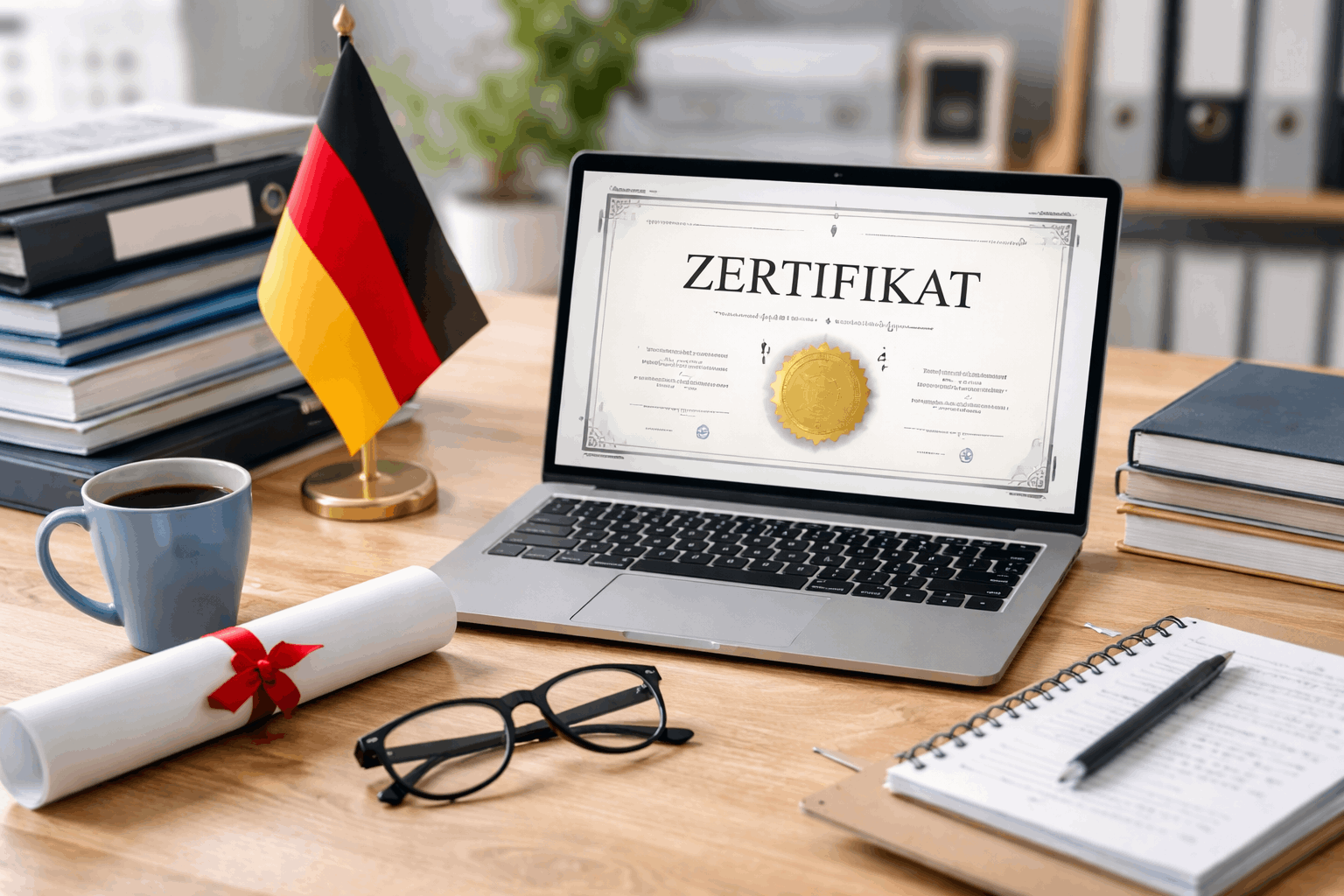
Choosing the right certification path for your goal
A good certification choice is one that employers explicitly request, is issued by a trusted body, and matches your realistic study time.
Germany’s vocational system is often described through the “dual” structure, linking workplace learning with school-based learning in many occupations.
If you write down your target job titles first, you can reverse-engineer the certification requirements instead of guessing.
Upskilling vs reskilling in German terms
Upskilling usually means Weiterbildung that deepens what you already do, while reskilling often looks like Umschulung toward a new occupation.
Funding rules and course formats can differ, so you should match the course category to your employment status and target timeline.
If you want speed, shorter certifications can work, but if you need a new occupational profile, longer programs can be the safer bet.
Regulated vs non-regulated occupations
Some professions have formal rules that affect whether you can work without a specific recognized qualification, while others are more flexible.
Recognition portals and official guidance can help you check whether your profession needs a recognition procedure before you can fully practice.
If your role is non-regulated, you may have more freedom to use industry certificates, but you still benefit from credible proof of skills.
Where to find credible certification programs and courses
Use official databases and chamber systems first, because they reduce the risk of enrolling in low-quality programs.
Germany offers public search tools for training and continuing education that help you compare providers and formats.
If you shortlist options, you can then validate whether a course is eligible for funding or tied to a recognized exam path.
Choosing a course is easier when you can see entry requirements, duration, and qualification outcome in one place.
Using KURSNET and “mein NOW” to compare options
Bundesagentur für Arbeit provides the KURSNET entry point and related modules for searching training and education offers.
The same ecosystem connects you to “mein NOW” tools that support finding Weiterbildung and Umschulung offers.
If you search by job goal and location, you can quickly filter into realistic options and then confirm the provider’s approval status.
Using IHK systems for exam-oriented Weiterbildung
The IHK network points learners to structured and continuing education examinations, often organized through official information systems.
If your goal is a credential that employers recognize across Germany, exam-based paths can provide stronger signaling.
When you see a course linked to an IHK exam outcome, treat the exam rules and prerequisites as the real “product” you are preparing to pass.
Funding your certification in Germany without guessing
Funding can be the difference between “nice idea” and “completed certification,” so you should check eligibility early.
Some of the most common support routes depend on your status as job seeker, employee, or career changer, and on the type of program.
If you plan to ask for public funding, you must verify whether the provider and measure meet the relevant approval requirements.
A funding-first approach also helps you avoid enrolling privately when an equivalent funded option exists.
Bildungsgutschein basics and what it can cover
The Bildungsgutschein is presented by the employment service as a way to support vocational Weiterbildung or Umschulung.
Official guidance emphasizes that the decision process involves counselling and confirmation of a suitable training goal.
If you are aiming for Bildungsgutschein funding, you should align your course choice with what your advisor can approve and what the market needs locally.
Recognition, proof, and how to keep your certificate credible
In Germany, recognition questions are especially important for foreign qualifications and for occupations with formal practice rules.
If you document learning outcomes, exam results, and issuing bodies clearly, you make it easier for HR teams to validate your claim.
A credibility mindset also protects you from low-value credentials that look impressive but do not change hiring decisions.

Recognition of foreign qualifications step by step
Anerkennung in Deutschland is the official federal information portal for the Recognition Act and explains procedures and counselling routes.
The recognition procedure is described as a competent authority checking whether your qualification is equivalent to the German reference occupation.
If you are unsure where to start, using the portal’s finder tools and guidance can help you identify the right authority and the typical document flow.
How to present certifications on your CV in a German-friendly way
Map each certification to a job-relevant skill set and state the issuing body, level, and assessment type instead of only listing the course name.
If a credential aligns with competence frameworks like the DQR levels, mentioning the level can improve clarity for employers comparing applicants.
For vocational training context, referencing the dual system concept can help explain your practical experience and structured learning pathway.
Conclusion
Pick one target role and extract the exact keywords that show up repeatedly in job ads, because that tells you what credentials matter most.
Search official databases and chamber systems first, then validate the provider, the outcome, and whether the program matches your goal.
If funding is relevant, start with counselling routes and eligibility checks before committing to any paid program.